Enzyme supplier for pet food manufacturing
Kibblewright helps pet food nutrition managers, formulators, and plant teams apply enzymes where they can make a practical difference: ingredient utilization, digestibility support, kibble consistency, palatability systems, and raw material flexibility.
We work from the realities of the line, not from a brochure. Your formula has protein meals, starches, fats, fibers, pulses, minerals, thermal exposure, moisture limits, coating constraints, and label requirements. Our role is to help you choose enzyme options that fit those realities and support commercial production at scale.
Enzymes matched to the formula, the process, and the target
Enzyme selection in pet food manufacturing is rarely a one-variable decision. The right approach depends on the ingredient matrix, when the enzyme is introduced, how it survives or avoids heat exposure, how evenly it disperses, and what outcome your technical team needs to verify.
Kibblewright supports enzyme planning for:
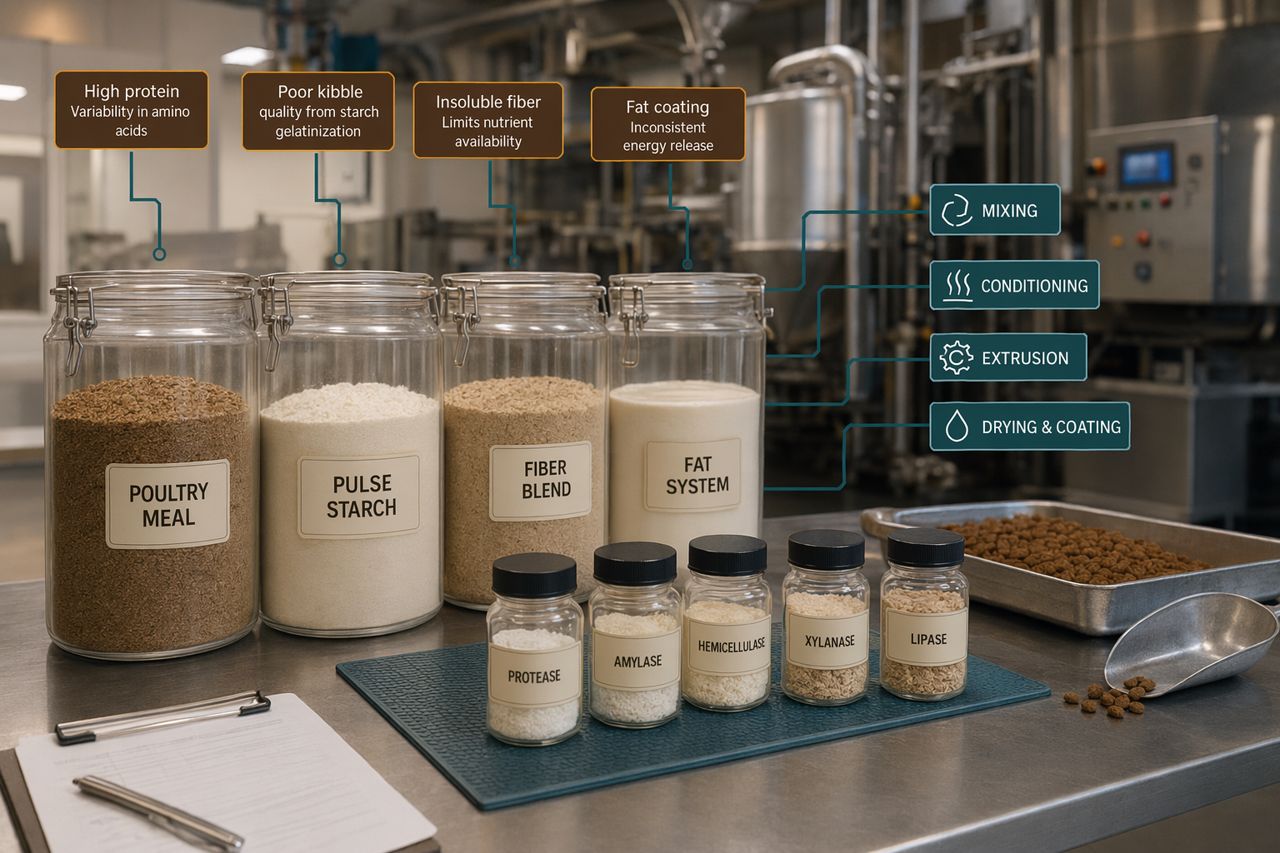
- Protein utilization: protease strategies for poultry meal, fish meal, meat meals, plant proteins, and mixed-protein systems.
- Starch and carbohydrate management: carbohydrase approaches for cereal grains, pulses, fibers, and complex carbohydrate fractions.
- Fat and palatability support: lipase-related applications where fat systems, coating steps, and aroma development matter.
- Functional digestive positioning: enzyme blends designed to support digestibility narratives within label and market constraints.
- Raw material variability: practical tools for maintaining performance when incoming ingredients shift by season, origin, or supplier.
Built for pet food factory conditions
Extrusion changes the enzyme conversation. Heat, shear, pressure, moisture, residence time, and post-dryer coating steps all shape what is possible.
We help technical teams think through:
- Preconditioner moisture and temperature windows
- Extruder thermal exposure and shear intensity
- Dryer and cooler residence conditions
- Post-coating versus pre-extrusion addition
- Liquid application, dry blending, or protected formats
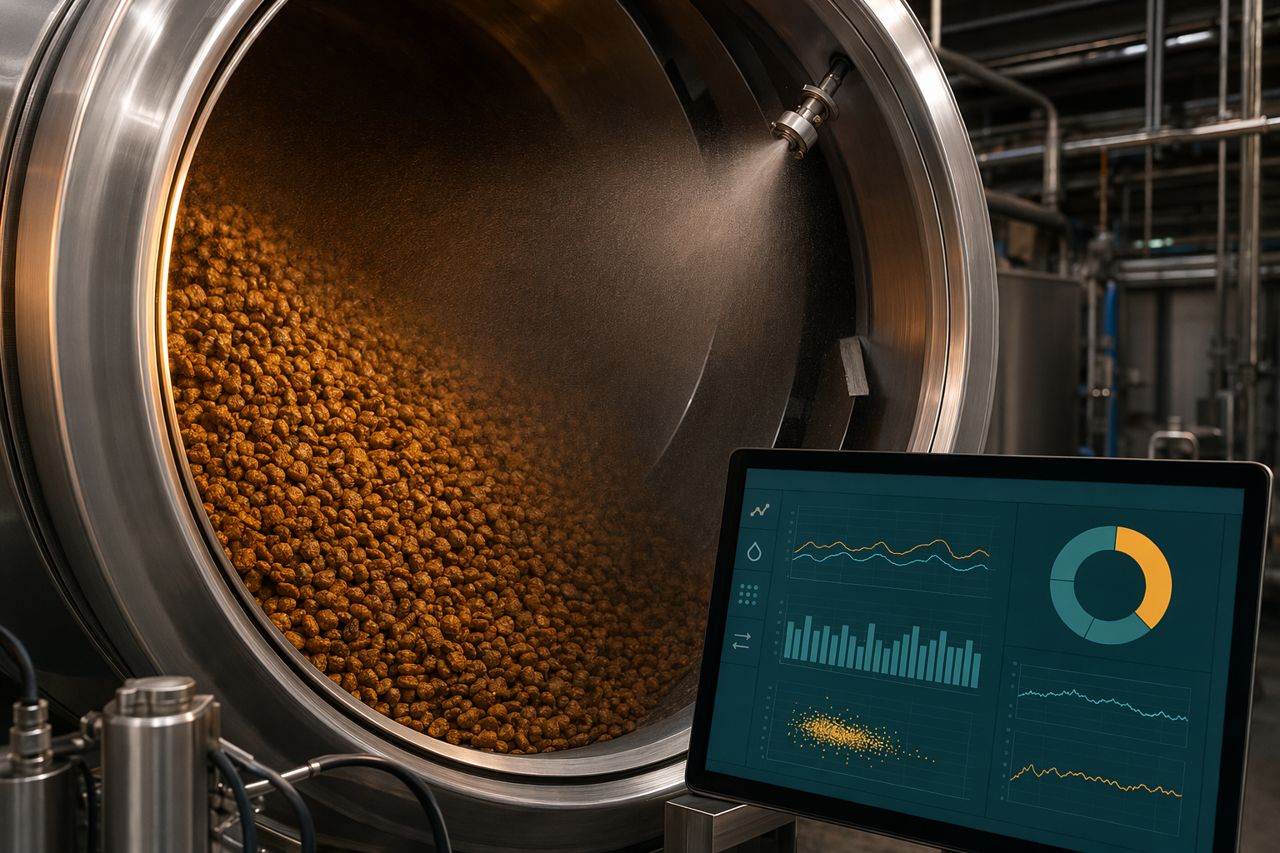
- Kibble surface coverage and dispersion consistency
- Compatibility with fats, palatants, acids, minerals, and preservatives
- Batch-to-batch handling for production-scale repeatability
The goal is not simply to add an enzyme. The goal is to place the right enzyme system in the right process position so it can support the intended outcome without disrupting plant flow.
Practical outcomes your team can evaluate
Kibblewright focuses on buyer value that nutrition and operations teams can actually track through formulation work, pilot runs, feeding observations, and production records.
Common targets include:
- Improved digestibility profile for selected protein or carbohydrate systems
- Better nutrient availability from challenging ingredient blends
- Support for stool quality objectives in companion animal diets
- More flexible use of plant proteins, pulses, or alternative raw materials
- More consistent kibble texture, density, and coating performance
- Reduced formulation friction when ingredient costs or supply availability change
- Cleaner scale-up from bench concept to production trial
For dry kibble, treats, and functional formats
Kibblewright supports enzyme planning for a range of pet food factory applications, including:
Dry extruded kibble
Enzyme strategies for protein digestion support, starch and fiber systems, post-coating applications, and formulas that need consistent production behavior across long runs.
Baked or formed treats
Enzyme applications for ingredient functionality, digestibility positioning, texture management, and process-compatible addition points.
Functional and premium formulations
Technical support for products positioned around digestion, protein quality, sensitive stomach claims, high-meat formulas, grain-free systems, or novel ingredient platforms.
Private label and contract manufacturing
Bulk enzyme supply and application support for factories managing multiple customer formulas, label constraints, and repeatable production schedules.
How Kibblewright works with your team
We start with a focused technical conversation. You do not need a perfect brief; you need a real manufacturing goal.
A typical project review covers:
- Formula context — major proteins, starches, fibers, fats, inclusions, and label restrictions.
- Process map — mixing, preconditioning, extrusion, drying, cooling, coating, and packaging steps.
- Target outcome — digestibility support, palatability support, stool quality, raw material flexibility, or process stability.
- Application route — dry blend, liquid system, protected format, or downstream addition.
- Scale-up plan — handling, storage, addition point, dispersion, and production trial expectations.
From there, we recommend practical enzyme options and quote bulk supply based on your production requirements.
Why pet food manufacturers choose Kibblewright
- Formulation-literate guidance for nutrition and technical teams
- Process-aware recommendations for extrusion and coating realities
- Bulk enzyme supply aligned to factory purchasing needs
- Support for ingredient variability and reformulation pressure
- Clear communication for R&D, QA, procurement, and plant operations
- Respect for label constraints and commercial production timelines
Request a quote
Tell us what you are making, what ingredient challenge you are solving, and where you expect the enzyme to fit in the process. Kibblewright will review your application and respond with practical next steps.
Use the on-site request a quote form below to share your formula type, target outcome, expected production volume, and preferred contact details.
Quote request details to include
- Product type: kibble, treat, topper, functional format, or other
- Main ingredient challenge: protein, starch, fiber, fat, palatability, or variability
- Process stage under consideration: pre-extrusion, post-dryer, coating, liquid application, or dry blend
- Desired commercial outcome
- Estimated monthly or annual enzyme requirement
- Any label, allergen, or handling constraints
Kibblewright is ready to help your team turn enzyme selection into a plant-ready manufacturing decision.